
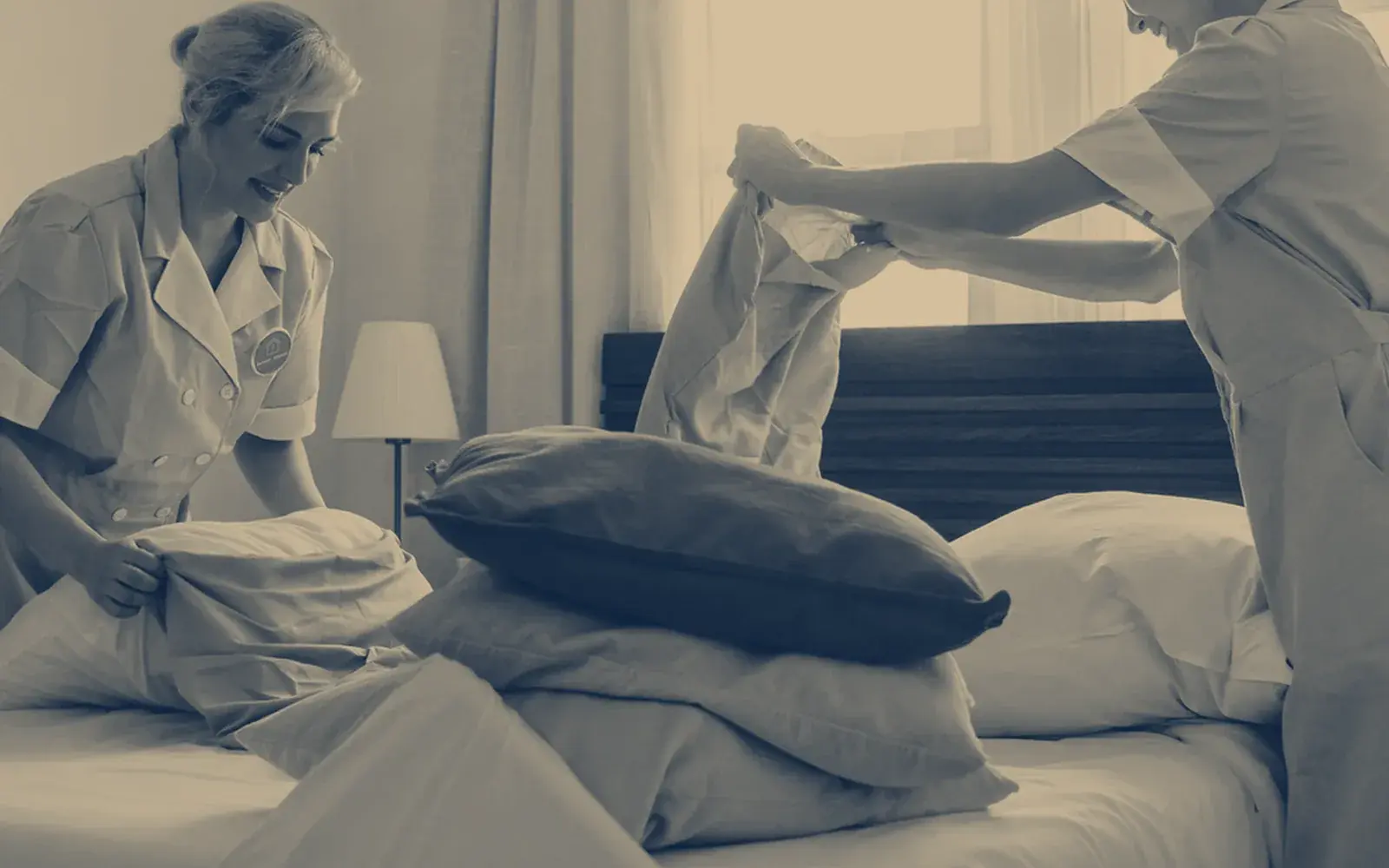
“Make yourself invisible.” For as long as I remember, that was the unwritten rule of luxury service. And it looked like this: You’d leave your room in the morning for breakfast. When you came back to use the bathroom before heading out, the room was already perfect again. Then, after using the bathroom, you’d leave a towel here and there, some trash, and go out once more. Right before leaving, you’d realize you’d forgotten your sunglasses and rush back to grab them. Surprise! The bathroom was spotless again. And you never crossed paths with a room attendant. That was seriously impressive. How did they pull it off?
Most guests never stopped to think about who “they” were: real people who move through the property like ghosts, and whose working conditions are almost entirely invisible to the people paying to stay there.
I have spent my entire career on the other side of that illusion. I have managed hotel operations in the United States, Turkey, Mexico, the Caribbean, Portugal, Brazil, and a beautiful island in French Polynesia. In some of these places, the nearest supply chain was a “once-a-week, 24-hour cargo-vessel-ride away,” while in others the staff commuted three hours to work every day, sometimes partly on foot.
I say this not to establish credentials but to explain why, when I talk about hotel sustainability, I am not talking about it from a conference panel or a certification document. I am talking about it from the ground. And from there, sustainability looks very different from how it does on a brand deck.
The thing I keep coming back to — the thing I couldn’t stop noticing no matter what country I was in — is how consistently the effort of a hotel’s green commitments finds its way onto the people who are already carrying the most: the room attendants, whom guests rarely see and whose names they almost never learn.
This piece is my attempt to offer a quiet homage to all the women and men who perform the most demanding work in hotels (across departments, not just in housekeeping), often without the public acknowledgment their dedication so clearly deserves, and too often without being counted as part of a hotel’s sustainability story.
Some of it will be uncomfortable for people who run hotels. It’s meant to be.
“I am talking about it from the ground. And from there, sustainability looks very different from how it does on a brand deck.”
What the job actually is, before we add anything to it
On a typical commercial property, a room attendant will clean between 14 and 18 rooms per shift. That’s roughly 20 to 30 minutes per room. In that time, they strip and remake the bed, clean the bathroom from tiles to toilet, vacuum, dust, restock all consumables, empty the bins, and ensure every surface passes inspection. They do this while pushing a cart that can weigh close to 190 pounds, across narrow walkways, or sometimes across open resorts in heat that exceeds 95 degrees Fahrenheit.
Ah! and, if by chance, they encounter a guest, they are expected to acknowledge them respectfully, to greet them warmly with a genuine smile, and respond to their questions in a calm and courteous manner.
Very rarely is the housekeeping staff’s opinion sought by architects or interior designers, so the room attendants will work in rooms that were not designed with their movement in mind: beds pushed against walls, floors that stain, extremely heavy furniture, bathrooms that require the room attendant to contort themselves around fixtures, showers that demand they kneel on tile.
The injury profile is consistent everywhere. It’s not dramatic. There’s no single accident. There’s a shoulder that starts to ache in year two. A lower back that becomes unreliable in year four or five. Wrists, knees, hips — all accumulate stress quietly, over years, in a job that the industry classifies as unskilled and pays accordingly. In the US, a study of injury records from 50 hotels found that housekeepers were injured at about 1.5 times the rate of hotel workers overall, and Hispanic housekeepers at roughly twice the rate. In countries with weaker labor protections, those injuries often go unreported, because reporting them feels more dangerous than enduring them.
This is the starting point. This is what we’re working with when we decide to layer a ‘green program’.
What “reuse your towels” looks like from the other side of the door
The linen reuse program is one of the most widespread sustainability initiatives in hospitality. You’ve seen the card. Leave your towels on the rack and you’ll help “save the planet.” I have implemented these programs myself, and I believe in the principle.
But I’ve also stood in the service corridor and watched what it does to a room attendant’s shift in practice.
On the floor, the room attendant now has to make a judgment call in each room: were those towels left on the rack because the guest opted in, or because they didn’t read the card, or because the towel has been there for three days and is, regardless of the program, no longer something you’d want to leave?
“Not one minute was added to the shift. Not one room was removed from the daily target.”
The room attendant has to track which rooms are at “night 1” versus “night 3” of a stay and adjust their stocking accordingly. On properties that have digitized their tracking — which is increasingly most of them — they’re entering this into an app on a tablet or phone, mid-corridor, in the time they don’t have.
I have seen properties that introduced a linen reuse scheme and a digital room-check system in the same quarter, without adjusting the room quota. The housekeeping team was expected to clean the same number of rooms at the same time while also recording more information per room. Not one minute was added to the shift. Not one room was removed from the daily target.
And then there are the other “green” practices, often rolled out all at once, without input from the staff who have to carry them out, and, frankly, of limited value in actually reducing a hotel’s environmental footprint: Is the room attendant opening or closing the blinds depending on the room’s heating or cooling needs? Turning off the lights in unoccupied rooms? Cleaning by natural light? Collecting partially used toilet paper rolls? Setting aside partially used bathroom amenities for donation? Avoiding running the tap or shower while she cleans? And on and on. Each one may sound reasonable on its own. Together, they are a dozen more tasks per room, and not one of them came with an extra minute either.
The psychological cost of all this — the constant judgment calls, the extra tasks, the sense of always being checked on — in a job that is already physically demanding, is an occupational health issue that sustainability conversations almost never address.
They probably should.
The chemicals on the cart
This is the one that bothers me most.
Walk through a hotel lobby that has a sustainability certification, and you will probably find a familiar list: no single-use plastic straws, refillable amenity dispensers in the bathrooms, perhaps a sign about the property’s carbon offset program. These are real improvements. I’m not dismissing them. But they are all things guests can see.
Now go to the housekeeping storage room — the one guests never enter — and look at what’s on the shelves.
Commercial cleaning products are among the most chemically aggressive substances used in any service industry. Bathroom descalers formulated with hydrochloric or phosphoric acid. Disinfectants built around ingredients such as quaternary ammonium compounds (“quats”), which are linked to health issues. These products are aerosolized in enclosed bathrooms, absorbed through skin during repeated contact, inhaled across an eight-hour shift, every working day, for years.
I have been in properties where the PPE (personal protective equipment) available to housekeeping staff was technically present — gloves in a box on the shelf — and practically inadequate. The gloves were the wrong weight for the chemicals being used, or the masks offered no real protection against chemical vapor. And worse, there was an unspoken expectation that moving quickly and not making a fuss was part of the job. Stopping to put on proper PPE, or raising a concern about a product, was the kind of thing that marked you out.
“The room attendant who develops occupational asthma from five years of quat exposure is not a line item on any sustainability report I have ever read.”
The contrast with the plastic straw is not rhetorical. It is structural. The straw is visible to guests. The decision to remove it costs almost nothing and generates measurable goodwill. The cleaning chemical is invisible to guests. Replacing it with a lower-toxicity alternative costs more, requires procurement work and staff retraining, and produces no visible signal to the person booking the room. The incentive structure of hospitality almost perfectly selects against making that substitution.
We have done it anyway, on properties we controlled, because we decided it was a non-negotiable. I know how hard it is to push that decision through when there are budget pressures. I also know that the room attendant who develops occupational asthma from five years of quat exposure is not a line item on any sustainability report I have ever read.
What the brand says versus what the cart carries
I think it’s easy to read this as a cynicism argument, and it’s not. The problem is not bad faith. The problem is a systematic bias built into the incentive structure of the industry.
Hotel sustainability, as it is currently practiced, selects for visibility.
- Removing straws: visible. Switching to safer cleaning chemicals: not visible.
- Electric car chargers in the parking lot: visible. Giving room attendants enough time per room to work without injuring themselves: not visible.
- Certified ethical coffee at breakfast: visible. Paying room attendants a living wage on direct employment contracts rather than agency arrangements: requires a guest to read a small paragraph on a website that most guests never find.
The people bearing the cost of this selection bias are exactly who you’d expect: the workers who are already most exposed and least powerful. In every country I have worked in, the housekeeping team has been disproportionately female, disproportionately from migrant or minority backgrounds, and disproportionately in the most precarious employment arrangements the local labor market permits.
The invisibility of housekeeping work is not accidental. It is a feature of how hotels are designed and operated. Service corridors exist so that guests don’t see the carts. And when housekeeping teams are also kept out of the sustainability story — when their workload, injury rates, and job security are missing from certification checklists — that invisibility becomes something more than operational. It becomes a choice.
What it actually looks like when a hotel gets it right
Not aspirationally. Concretely. Because I have seen it.

The first thing I look for is the room quota. It is, in my experience, the single most honest indicator of how seriously a property takes its housekeeping team. A hotel that has looked at what a human being can actually clean in the time available is making a statement about its values that no certification can fake. It means higher staffing costs. The properties I’ve run where I enforced this had lower injury rates, lower turnover, and better cleanliness scores. People who are not racing do better work.
The second thing I look for is how injuries are actually handled — not the policy in the handbook, but what happens on the floor. In a property that genuinely values its housekeeping staff, someone who reports a shoulder problem gets modified duties and access to medical care without any ambiguity about their job security. Injury data is used to improve equipment and processes. I have been in properties where the GM could tell you the musculoskeletal injury rate by department and what had changed in the last year to address it. Those are the properties I want to return to.
The third thing is employment terms. I have used agency arrangements. I understand the operational logic. I also know what they do to people: they make it rational to tolerate bad conditions rather than report them. A hotel that employs its housekeeping team directly, on permanent or long-term contracts, with real sick pay, holiday entitlement, and benefits, is giving those people the basic material security to report a problem without risking their livelihood. It is one of the most consequential things a hotel operator can do, and it is almost never mentioned in sustainability communications.
The fourth thing is the chemicals. I look at what’s in the storage room before I look at what’s in the lobby. Were the harshest products replaced because of what they do to the people using them, not just to the environment? Is the PPE actually matched to the products being used? Are the bathrooms ventilated while they’re being cleaned? And can a room attendant raise a concern about a product without it marking her out?
“I look at what’s in the storage room before I look at what’s in the lobby.”
The fifth thing, and the one that is probably most telling, is whether the housekeeping team is visible. Not in a tokenistic way — not a photograph of smiling staff on the website. Visible in the sense of: does management know their names? Are working conditions and living wages included in sustainability discussions and reporting alongside energy consumption and carbon figures?
None of this requires a certification. Some of the most genuinely staff-centered properties I have worked in, or visited, had no formal sustainability label at all. What they had was management — often owners or GMs — who had decided, early and firmly, that the conditions of their staff were not negotiable. That decision shaped everything else: the quotas, the contracts, the chemicals, the culture.
Sustainability reporting in hospitality tends to count what is easy to count: kilowatt-hours, water use, plastic avoided, carbon offsets. The room attendants’ health and safety never show up in those numbers.
The most sustainable hotel is not the one with the greenest brochure. It is the one where, years from now, the woman who made every bed can still lift her arms, still pay her bills, and still say with pride that this was good work. That is the version of sustainability I want to see measured, reported, and rewarded.
She is a person, not a metric. And the industry I have spent my career in has, for too long, treated her as neither.
About the author
Rui Reis is a hospitality leader with over 30 years of experience managing luxury hotels and resorts across the Americas, Europe, and Polynesia. His work has consistently focused on how to deliver high-end guest experiences while maintaining a strong connection to place, community, and long-term stewardship.
As Divisional Managing Director at Belmond for North, Central America, and the Caribbean, Rui oversaw a portfolio of distinctive properties including Cap Juluca, La Samanna, El Encanto, and Maroma. Across these properties, he emphasized operational excellence alongside a deeper integration of local context, from community engagement to cultural expression, ensuring that each hotel reflected its surroundings rather than operating apart from them.
Earlier in his career, Rui held senior operational roles at Starwood Hotels & Resorts, where he led the opening and positioning of several flagship properties, including The St. Regis Istanbul, The St. Regis Mexico City, and The St. Regis Bora Bora. His work across these projects reinforced a core belief: that luxury is not defined only by product, but by how a hotel relates to its environment, its people, and the destination it inhabits.
Throughout his career, Rui has worked to evolve how luxury hospitality approaches responsibility. Rather than treating sustainability as an add-on, he has integrated it into daily operations, from reducing environmental impact and rethinking food systems, to embedding local culture and partnerships into the guest experience. His approach reflects a practical understanding of tradeoffs, showing that high-performance luxury and responsible practices are not in conflict, but can reinforce each other when grounded in real operations.
At CRH, Rui brings an operator’s perspective on what it takes to implement responsible hospitality at scale within complex, high-expectation environments. His experience helps bridge ambition and execution, ensuring that responsibility is not just defined, but delivered in ways that are both credible and commercially viable.
Rui holds a Certificate in Hotel Real Estate Investments and Asset Management from Cornell University and is a graduate of the Escola de Hotelaria e Turismo do Porto.